
The global cement market represents about $428.5 billion in 2025, with a targeted European market of $62 billion in 2026. Global production reached 3.8 billion metric tons in 2025, with China alone accounting for roughly 55%. Despite this considerable economic weight, the sector is responsible for 7-8% of global fossil fuel-related CO₂ emissions, with each ton of cement produced through the traditional Portland process emitting around 673 kg of CO₂.
There is a sharp contrast between the urgency of the sector’s transformation and the funding capacity currently available to achieve it. Indeed, the investment landscape for European cement startups has proven highly volatile over the last few years: total fundings experienced a sharp decline since 2024, although early market indicators show a recovery as of June 2026, with total fundings already bouncing back to 2024 levels. More broadly, Europe’s venture capital ecosystem focused on cement and construction innovation appears under-capitalized compared to the United States, likely by a factor of 4, despite the region’s stronger regulatory and societal push toward decarbonization (CBAM, EU ETS free-allowance phase-out starting 2026). As with manufacturing more broadly, we firmly believe that the cement sector will need startup-driven innovation to successfully complete its transition and remain competitive under this growing regulatory pressure.
This begs the following question: How can the cement industry decarbonize while remaining competitive?
There are many ways to answer this question, however on this article we will focus on how technological innovation can start transforming the cement value chain. First, we need to understand what this value chain actually is. It is structured into 6 stages, split between upstream and downstream, each associated with a specific level of CO₂ emissions:
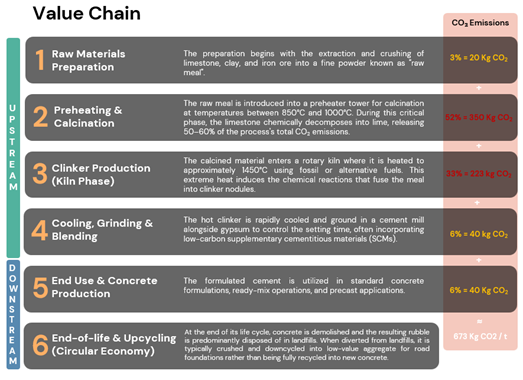
Source: Aster, based on GIEC (IPCC) – Task Force on National Greenhouse Gas Inventories
Unfortunately, in most cases, this value chain suffers from a number of challenges:
- Strong regionalization: high transport costs (15-25% of final price) limit distribution to roughly a 300km radius, creating quasi-captive local markets rather than a unified global market.
- Extreme vertical integration: most of the key players control the entire chain, from quarry to end customer, with value concentrated in clinker production and grinding, where significant economies of scale exist.
- Unbalanced geographic concentration: excess Chinese production is exerting deflationary pressure on global clinker prices, threatening non-dominant regional producers.
- Regulatory acceleration: the definitive launch of CBAM (transition period ended Q4 2025) and the phase-out of free EU ETS allowances (a 2.5% reduction in 2026, 5% in 2027, up to 48.5% by 2030) are placing massive CAPEX requirements on high-clinker cement producers.
The main challenge for the sector is that, in order to reduce CO₂ emissions, substantial capital investments (CAPEX) are required, which represents a strong barrier to entry for any startup. That is further made harder by the presence of large incumbents with deep vertical integration.
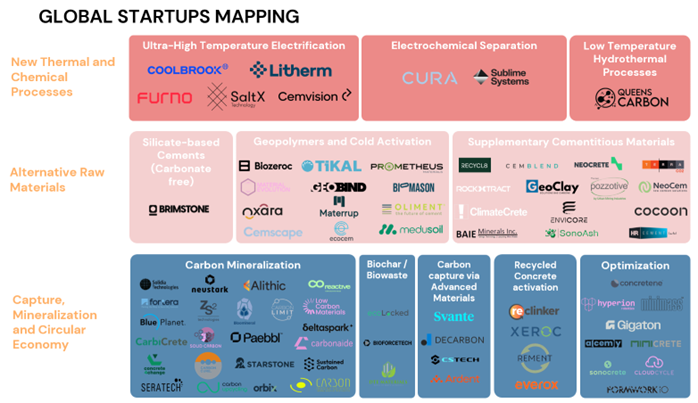
Nevertheless we believe that startups can help the cement industry decarbonize through 3 major technology families:
- New Thermal and Chemical Processes: replacing fossil-fuel-fired kilns with electrical technologies (ultra-high temperature electrification), electrochemical separation processes operating at ambient temperature, or low-temperature hydrothermal processes, in order to bypass traditional heat thresholds while facilitating CO₂ capture.
- Alternative Raw Materials: developing carbonate-free silicate-based cements, geopolymers activated through cold activation (from raw clay or excavated earth), and supplementary cementitious materials (slag, ash, mine tailings) to dilute, or even eliminate, the clinker share in the mix.
- Capture, Mineralization and Circular Economy: mineralizing captured CO₂ to create a permanent carbon sink, valorizing biochar/biowaste, capturing carbon via advanced materials (MOFs), reactivating recycled concrete, and optimizing the entire process through artificial intelligence.
Source: Aster
Our view is that, in the short to medium term, the vast majority of startups will continue to position themselves as technology enablers rather than direct competitors to incumbents: they aim to license their technology and secure large-scale deployment contracts with giants like Holcim or Cemex, or ultimately be acquired. A more disruptive niche of deeptech startups, however, is endeavoring to build parallel value chains by financing their own plants to produce clinker-free, cold-activated cement that completely bypasses traditional kilns. Against this backdrop, we believe that startups that will stand out in the space will be those that:
- Target the most emissions-intensive stages of the value chain: Preheating & Calcination and Clinker Production alone account for 85% of process emissions (573 kg of CO₂ out of the 673 kg emitted per ton).
- Offer “drop-in” solutions compatible with existing standards and infrastructure (for example, a Supersulfated Cement chemistry meeting existing EU standards), to minimize regulatory barriers and adoption costs.
- Secure large-scale offtake and deployment agreements with industry giants (Holcim, Cemex, Vattenfall…) to demonstrate real commercial traction.
- Reach a high Technology Readiness Level (TRL), an essential condition for reassuring a capital-intensive, conservative, and heavily regulated industry.
- Embed circular economy principles, valorizing both upstream industrial waste (alternative raw materials) and downstream construction waste (recycled concrete reactivation, upcycling).
These technology families won’t fix the cement sector’s CAPEX intensity or its incumbents’ grip overnight, but they’re where we believe the next decade of value creation will happen.
Hey you! If this resonates, ping us on LinkedIn: we’d love to hear from you.
Sources :
- The International Energy Agency, Demand and Supply Measures for the Steel and Cement Transition, 07 May 2026.
- Regulation (EU) 2025/2083 of the European Parliament and of the Council of 8 October 2025 amending Regulation (EU) 2023/956 as regards simplifying and strengthening the carbon border adjustment mechanism.
- 2025 Net-Zero Pathways for European Cement, BELLONA REPORT.
- Marmier, A., Decarbonisation options for the cement industry, EUR 31378 EN, Publications Office of the European Union, Luxembourg, 2023.
- “Implementing carbon capture technologies and strategies in the cement industry: A complete review”; Odwin Ekunke Odor, Christian Davison Dirisu, Nicodemus Chidera Omekawum, Ademayowa Isaac Adejumobi, Victory Olamide Olorunfemi and Abiola Olufemi Ajayi, 07 July 2025.